Ranthambhor National Park/Ranthambhor Regency Hotel

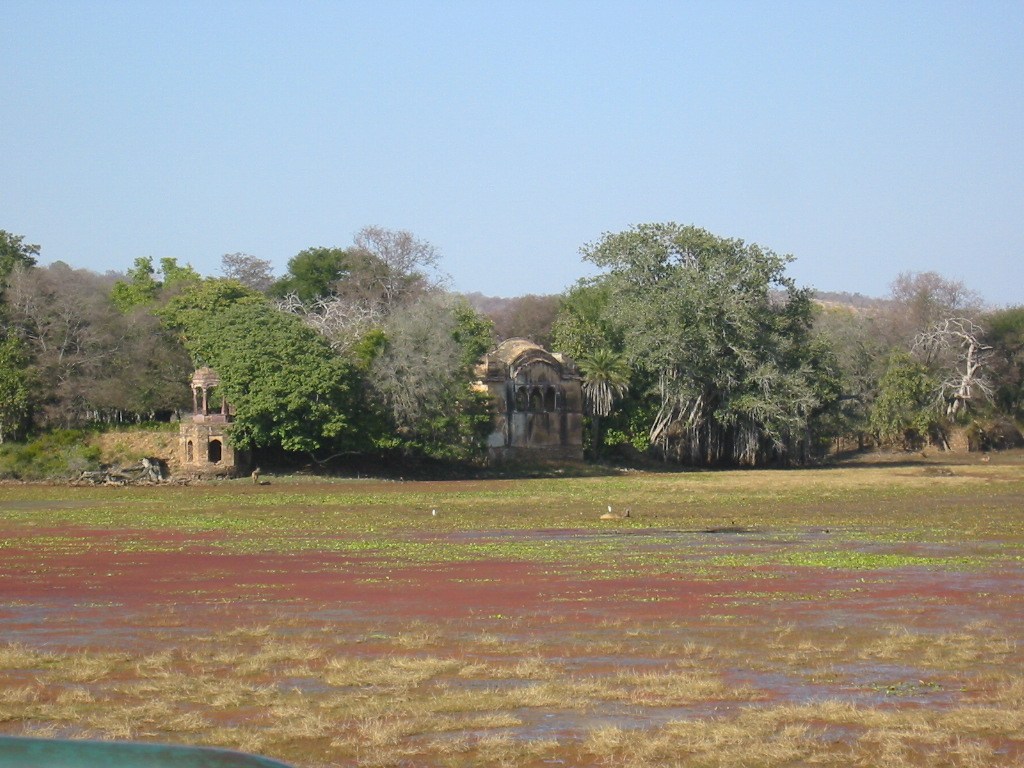
 Ranthambhor is a
region synonymous with tigers and tiger hunting. Much like
nearby Bharatapur, Ranthambhor was a preserve where the
maharajas engaged in this, their favorite royal pastime. Today
the tigers enjoy protected status in the Ranthambhor National
Park. Evidence of the tiger hunts of yesterday remain, in the
form of the maharaja's hunting lodge, shown in the photo
above. Access to the park takes guests past the Ranthambhor
Fort, (photo to the left) which overlooks the jungle below; in
a fashion similar to medieval moats, its' Hindu architects
designed the jungle as a vital cog in the fort's defenses. The
park is home to a variety of wildlife, most of it more
plentiful and accessible than the tigers. The first animal
that we encountered after passing through the Jurassic
Park-like gates of the entrance were wild boar, one of which
is shown in the photo to the right.
Ranthambhor is a
region synonymous with tigers and tiger hunting. Much like
nearby Bharatapur, Ranthambhor was a preserve where the
maharajas engaged in this, their favorite royal pastime. Today
the tigers enjoy protected status in the Ranthambhor National
Park. Evidence of the tiger hunts of yesterday remain, in the
form of the maharaja's hunting lodge, shown in the photo
above. Access to the park takes guests past the Ranthambhor
Fort, (photo to the left) which overlooks the jungle below; in
a fashion similar to medieval moats, its' Hindu architects
designed the jungle as a vital cog in the fort's defenses. The
park is home to a variety of wildlife, most of it more
plentiful and accessible than the tigers. The first animal
that we encountered after passing through the Jurassic
Park-like gates of the entrance were wild boar, one of which
is shown in the photo to the right.

 There was no lack of wildlife to observe as we
rode through the forest and jungle areas on flatbed trucks
equipped with seats, a frosty ride at 6 a.m. on a February
morning! The park is well-stocked with herds of deer, and they
seemed nonplussed by the many vehicles whizzing by on the dirt
paths. Two types of deer are found in the Ranthambhor National
Park. There are the larger Sambar deer, large animals
who resemble their North American counterparts. White spotted
deer are also plentiful, and these deer tend to be smaller
than the Sambar. The photo to the left shows a Sambar buck in
a clearing, while the photo to the right shows a group of
three spotted deer, a mature buck, a doe and a young "button"
buck.
There was no lack of wildlife to observe as we
rode through the forest and jungle areas on flatbed trucks
equipped with seats, a frosty ride at 6 a.m. on a February
morning! The park is well-stocked with herds of deer, and they
seemed nonplussed by the many vehicles whizzing by on the dirt
paths. Two types of deer are found in the Ranthambhor National
Park. There are the larger Sambar deer, large animals
who resemble their North American counterparts. White spotted
deer are also plentiful, and these deer tend to be smaller
than the Sambar. The photo to the left shows a Sambar buck in
a clearing, while the photo to the right shows a group of
three spotted deer, a mature buck, a doe and a young "button"
buck.

 While tigers are
the featured species at Ranthambhor National Park, they remain
relatively elusive, with about 40 some tigers on the preserve.
We were not fortunate enough to spot a tiger, and had to
settle for several sets of fresh tracks. However, other guests
at our hotel had better luck, spotting a tiger on each of the
three outings, proving that we were not in fact on an Indian
version of the snipe hunt. Still, it was a rewarding
experience. On our second trip we spotted the Asian antelope,
which looked like a cross between a horse and a hippopotamus!
It is shown in the photo to the left, while the photo to the
right shows one of the many peacocks found on the grounds.
While tigers are
the featured species at Ranthambhor National Park, they remain
relatively elusive, with about 40 some tigers on the preserve.
We were not fortunate enough to spot a tiger, and had to
settle for several sets of fresh tracks. However, other guests
at our hotel had better luck, spotting a tiger on each of the
three outings, proving that we were not in fact on an Indian
version of the snipe hunt. Still, it was a rewarding
experience. On our second trip we spotted the Asian antelope,
which looked like a cross between a horse and a hippopotamus!
It is shown in the photo to the left, while the photo to the
right shows one of the many peacocks found on the grounds.

 Ranthambhor
also
has a great deal of wetland, similar to that found at Keoladeo
Ghana Sanctuary. These were good spots to look for wildlife,
as they flock to the waterholes to drink. The photo to the
left shows a pair of monkeys, just two members of the tribes
of monkeys that surrounded Rajbagh Talao lake bank. The photo
to the left shows a crocodile basking on the lake shore. Also
visible in the distance were large herds of deer, antelopes,
and gazelles. The hunting lodge featured at the top of the
page was also located on Rajbagh Talao lake.
Ranthambhor
also
has a great deal of wetland, similar to that found at Keoladeo
Ghana Sanctuary. These were good spots to look for wildlife,
as they flock to the waterholes to drink. The photo to the
left shows a pair of monkeys, just two members of the tribes
of monkeys that surrounded Rajbagh Talao lake bank. The photo
to the left shows a crocodile basking on the lake shore. Also
visible in the distance were large herds of deer, antelopes,
and gazelles. The hunting lodge featured at the top of the
page was also located on Rajbagh Talao lake.


While on safari, we stayed
at the Ranthambhor Regency Hotel, a few kilometers from the
park, The hotel was designed very much like a hunting lodge,
with rustic rooms around a central courtyard. The photo to
the immediate left shows the main entryway to the
Ranthambhor Regency Hotel. From the lobby at the front of
the hotel one passes by a corridor of rooms which in turn
open onto a large courtyard with a pool (photo to the
right). Meals are served in a large dining hall just beyond
the pool. Although it looks inviting, the water was very cold when we visited, and there was not
much lounging around the pool. Still a few brave
(foolhardy?) members of our group did take the plunge, while
others made certain that none of the guests were too comfortable in their chairs
by constantly booting a soccer ball in the courtyard area.
The photo to the bottom left shows one of the rooms.
Decorated in lodge style, they boasted wooden bed frames, a
large armoire, a set of chairs and coffee table. A
television was provided (no  English channels!) and the cold of the marble floor was buffered by carpets.
All in all, a comfortable retreat from the rigors of bouncing
around on the back of a truck, buffeted by the cold February
air. More bracing than the outdoor adventures was the wait for
the water in the shower to become hot!
English channels!) and the cold of the marble floor was buffered by carpets.
All in all, a comfortable retreat from the rigors of bouncing
around on the back of a truck, buffeted by the cold February
air. More bracing than the outdoor adventures was the wait for
the water in the shower to become hot!
